Design in India in 2026 has dramatically expanded its visibility and reach. Sixty-five years after the India Report (Eames) of 1958, design has become an accepted area of study by Indian parents, and students can now expect to secure a well-compensated professional pathway. There are now over 2,000 design education options in the country, covering every imaginable sector and type of design practice – and causing much market confusion for parents and students, and to some degree companies and diverse design communities.
Up until the first decade of the 21st century, many design graduates left India due to a lack of domestic opportunities and low salaries. In 2025, approximately 25,000 design graduates emerged from a myriad of design programs, with strong domestic demand outstripping supply (which may be expanding at an annual rate of 23–25%). Graduates are being employed by a growing number of companies and organizations in India that view design as a necessary function and/or capability to secure opportunities, and salaries are competitive.
Design globally is about applying human-centered design principles, frameworks, and practices to improve products and services for people and markets, impacting better tomorrows. Designers are increasingly using multidisciplinary principles and methods to intentionally identify underlying values, behaviors, and actions that inform product and service infrastructures, thereby improving outcomes and agency. Agency is more than greater engagement; it is about securing a greater say in the structure and benefits of products and services within specific social, political, and economic forces.
Unlike other parts of the world, India has historically placed an emphasis on the social dimension, as outlined in the India report, which defined design’s responsibility as focusing on the needs of the village. This was complementary to wider Indian culture and political movements that addressed the socio-economic needs of the unserved. Many companies have well-established Corporate & Social Responsibility programs to address the underresourced needs of these populations.
Indian society now seeks to recontextualize its various state cultures and socio-economic classes, combining situated beliefs and cultural knowledge with global influences. This is creating a hybrid culture where local and global coexist in dynamic contemporary realities across the sub-continent. To be clear, there is no single dominant pan-Indian perspective as the sub-continent is a coalition of 28 states and eight union territories, each with its own language and culture. Still, there are basic pan-India touchstones that define a shared Indian cultural destiny, such as pluralistic democratic coexistence, relational social structures, and continual, adaptive, non-deterministic continuities.
India today has become more self-confident and aspires to chart its own authentic future. It seeks to project this confidence to improve its internal markets, meet international standards, and become a global leader in specific industries. As India approaches its centenary of independence in 2047, how can design education programs and companies address the needs and opportunities of an increasingly urban mix of wealthy, middle-class, aspiring middle-class, and poor? How can designers in India be educated and trained to be exposed to the range of socio-economic and political conditions across all sectors and markets so that they can be adaptable contributors throughout their practice lifetimes? Ashish Bansal, who focuses on design research and was at Samsung India, stated, “It’s not just multidisciplinary adaptability; it is also about contextual elasticity. A designer in India must understand how a premium brand (desire) is disrupted by a low-cost digital service (want). So, Indian designers aren’t just generalists, they are complexity managers.”
India’s transformation from socialism to capitalism
For eighty years, India has experimented with political and economic systems to shape its complex social landscapes. India’s independence movements were dynamic and espoused social capital and empowerment, spanning the spectrum from Marxism to socialism. At independence in 1947, under Jawaharlal Nehru’s leadership, the country faced many challenges stemming from colonial rule and widespread poverty.
During the Cold War, India joined the Non-Aligned Movement to gain greater flexibility in its relations with the United States and the Soviet Union. Being non-aligned was necessary to secure favorable trade relations and avoid being drawn into Cold War-driven foreign policy entanglements. Nehru guided early independent India under socialist principles, in which the central government set policies to achieve a high degree of economic control and coordination, increasing self-reliance and building infrastructure.
There was a focus on engineering, agriculture, and the establishment of basic civic infrastructure to address a population where 80% of the 340 million people (250 million) lived in poverty. In 1947, 90% of India’s population lived in rural areas, and 55% lived below the international poverty line. The First Five-Year Plan (1951–56) was conservative in its goals, reducing imports of foreign goods wherever possible and tapping into domestic self-reliance. The GDP at the time was $30.6 billion USD (inflation-adjusted, it would be equivalent to $480–500 billion USD today).
Until 1958, design was associated with the craft sector (and this is still mostly true today), which at that time accounted for about 83% of the total rural population, which faced chronic underemployment and low incomes. Textiles accounted for a significant share of the crafts sector, and as fate would have it, brought contemporary design to India. In 1955, at the Museum of Modern Art, an exhibition called “Textiles and Ornamental Arts in India” was spearheaded by Pupul Jayakar and designed by Alexander Girard. Charles and Ray Eames attended this event, and the Sarabhai family of Ahmedabad invited both to visit India.
Supported by the Ford Foundation, they visited in 1958 for three months in order to make informed recommendations for a design training program to support small industries and maintain the quality of domestic consumer goods. From this visit, the Eameses drafted the India Report (commonly known as the Eames Report) in April 1958. This point of view was to “… recommend that without delay there be a sober investigation into those values and those qualities that Indians hold important to a good life, that there be a close scrutiny of those elements that go to make up a ‘Standard of Living.” This spanned food, shelter, distribution, and population, and focused on the village’s central role and unmet needs, which, at the time, were the key social constructs of post-independence India. They proposed a design academy under the Ministry of Commerce to explore key questions for the design institute to address the ” . . . impatient national conscience — a conscience concerned with the quality and ultimate values of the environment” and ” . . . take a close look at those things that constitute a “Standard of Living” in India.”
- How do they vary according to time, place and situation?
- What are the real values?
- To what degree is snobbery and pretension linked with standard of living?
- How much pretension can a young Republic afford?
- What does India ultimately desire?
- What do Indians desire for themselves and for India?
These broad questions, from 1958 onward, used contemporary design as a lens to inform research, training, and service for decades through the National Institute of Design’s activities in Ahmedabad, India. Within the construct of a socialist society, the India Report aligned well with a focus on addressing the needs of the village, particularly the crafts sector, to improve their standard of living by design.
A decade after the India Report, Victor Papanek published his watershed book “Design for the Real World : Human Ecology and Social Change” which outlined that design, which traditionally focused on enhancing middle-class living and consumerism around the world, should also focus on socially responsible, accessible, and real-world problems of the developing world – or what he called design for the other 90%. Papanek’s call to shift from servicing markets to designing with humanity was aligned with post-independence India.
In 1990, there were growing concerns in India about the performance of a centralized economic system. Much of the early benefits and growth using socialist levers were slowing, affecting the sub-continent’s ability to link population growth to economic opportunity through higher GDP growth. In 1990, India had only two weeks of foreign reserves available, a large fiscal deficit, and high inflation, and had to use its gold reserves to secure international loans. Also, the fall of the Soviet Union, a major trading partner, could have been a driver for economic change. Manmohan Singh, as Finance Minister in the 1990s, architected economic liberalization through market-oriented structural reforms. His efforts included reducing state control over planning and licensing, reducing tariffs, devaluing the rupee, and increasing exports and foreign investment. Singh’s efforts provided the foundation for long-term growth and the creation of new sectors to drive it.
Fast forward over 30 years and 75 years of independence, and India is economically liberalized and free-market-oriented, with a GDP of $4.13 trillion and a 6.6% growth rate. Mobile technologies, UPI, and 3G networks have unleashed a dizzying amount of economic activity, which even the poorest rural villagers benefit from. Extreme poverty in India has fallen to approximately 2.3% of the population according to the World Bank, and is one of the most dramatic reductions in poverty in human history. Historical scarcity, in many cases, has been replaced with conspicuous consumption and status. Yet the memories of scarcity still drive value consciousness, even among the wealthy, and also drive the historical focus on value engineering in India to make cost-effective products with the performance features of major overseas brands.
India aspires to be a US$10 trillion economy by 2047, the centenary of Indian independence, under Viksit Bharat@2047 (Developed India). This initiative has a central vision “Amrit Kaal,” to transform India into a self-reliant, developed nation through infrastructure, digitalization, and sectoral growth. Given the progress made from 1990 to 2025, it is not a huge stretch to think that if India can continue to grow at 6% per year, it can grow a four-trillion-dollar economy into a 10-trillion-dollar economy in about two decades.
India’s three population segments where design operates
The India Report defined the role of design in improving the crafts sector and raising the quality of life in villages. From 1958 to the turn of the century, there were two main art and design programs in India : The National Institute of Design in Ahmedabad (now with seven campuses); and the Industrial Design Center at IIT Mumbai, which graduated a few hundred designers per year. As stated earlier, in 2026, over 2,000 design programs graduate approximately 25,000 designers each year, who enter a wide range of sectors and applications. This explosive growth of programs reflects the growth of the Indian economy and the reconfiguration of economic bands that drive social and political institutions.
With economic liberalization, there seem to be three key sector economies that designers engage with :
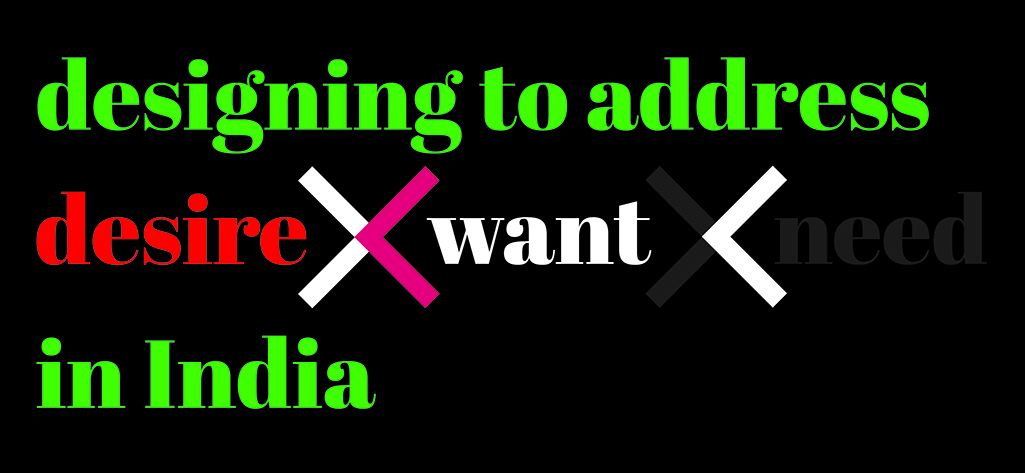
- The desire economy = wealthy & middle class
- The want economy = aspiring middle class
- The need economy = the unserved class
The desire economy encompasses the wealthy and the middle class, the fastest-growing socio-economic segment, accounting for 20% to 35% of the population (300 to 400 million people). While there is no official definition of the middle class in India, it can be defined as those earning $10-$50 or more per day. The sub-continent now has the largest middle class in the world, exercising a wide range of social and economic consumption and privilege. They seek an authentic blending of pan-indian and international cues and performance. Designers are front and center, designing for the desire economy as new wealth supports it.
The want economy encompasses the aspiring middle class, the largest socio-economic segment, which could account for 30% to 40% of the population (400 to 550 million people). Often defined as those earning $4 to $10 per day, they have growing purchasing power to consistently purchase discretionary goods and services. While economically fragile and underserved, they aspire to move into middle-class living and benefit from the halo effect of wealthy and middle-class activities. They don’t want cheap versions of premium products but reengineered, smart versions that can serve as a bridge to the desire economy.
The need economy encompasses unserved groups. This economic segment, roughly 350 million to 530 million people, earns $3 or less per day. Available resources leave little, if any, discretionary purchasing power. What intermittent purchasing power they do have is used to secure consumer durables such as mobile phones, televisions, and small two-wheeled motorized vehicles—alongside snacks, tea, and tobacco. They seek to find ways to participate in some form of enlarged benefits that they want and desire economies project.
These three economic zones loosely define the internal markets within the sub-continent. Like all economies, they do not exist in isolation; they interact, can affect one another, and have halo effects. For example, there has been a wealth-creation halo effect on lower-income urban and rural populations in the want-and-need economies, whose quality of life is improving as they move from the basics toward aspirations for higher living standards. The role of mobile advertising and social media has increased visibility and awareness. It has instilled a desire to secure products and services at lower price points, creating behaviors that, over time, move upward toward middle-class lifestyles.
There is a connection between earnings, consumption, and power. Power and agency are connected because individual and group agency and power are hierarchically connected, with higher levels determining the scope of decision-making in design available to those below. If part of design’s role is to increase human agency through the application of human-centered frameworks and methods, then issues of shifting power play a key role in what design can offer to change a particular status quo.
To many, design is about creating products and services that increase engagement through surface treatments, status, and convenience. To others, design is about directly addressing underlying socio-economic forces that block progress and by creating foundational product/service infrastructures to ameliorate injustices and increase human agency. These two paths are tugging at the many types of design practice in India, meshed with issues of tradition and modernity that need to be taken into account in any design response.
Designing with cross segments in mind
Since 1851, when contemporary design emerged at the Great Exhibition of the Works of Industry of All Nations in London, the role of design has been to support industry in designing products and services for the middle class. For over 150 years, mainstream design has focused on companies, organizations, and governments to improve the overall middle-class experience and quality of life. Design education’s focus has been to orient design graduates to design for these segments, where abundant resources support professional design practice within companies and organizations that cater to these important markets.
The desires of the sub-continent’s wealthy and middle class have become fertile ground for design (reflecting mainline design’s role globally). Enticing people to invest excess resources to secure goods and services to enhance psychological, sociological, and emotional wants that drive choice, status, convenience, and leisure. This can lead to conspicuous consumption propelled by a constant drive to replace the old through product enhancements and relentless marketing that entice consumers to keep consuming.
International brands were a way to support status consumerism preferences. Now, there is a growing number of Indian brands competing on design and marketing, driven by consumer desire to purchase Indian products and services that are on par with international alternatives. Even the historically challenged Indian craft sector is now pairing contemporary designers with local artisans to reinterpret craft, combining traditional and modern materials and technologies with brand marketing techniques to achieve higher price points and margins.
Many design students come from the aspiring middle class, middle class, and wealthy classes, and their perspectives are shaped by their lived experience, having been insulated from interacting with the poor in India. Like any field, you practice what you know, and in this case, it is designing for the very economic classes they grew up in. They have little firsthand experience of the realities of the need economy.
Many of the main four-year undergraduate design programs are shaping their curricula and pedagogy to prepare students to operate in the desire economy. Projects focus on phygital products and services that embed desire and status through a confluence of brand and marketing. The desire economy is where the resources are to support design functions and capabilities, and to provide a continual roadmap for designing and redesigning products and services.
A large number of design graduates are joining corporations with design functions and capabilities that cater to the desire economy and the insatiable needs of India’s wealthy and middle class. Sub-continent designers are playing an important role in creating more desirable and increasingly internationally competitive products and services that meet the expectations of domestic middle-class markets. It is a perfect alignment of mainstream design and its function to create and enhance brands that deliver a myriad of interconnected products and service landscapes.
Some programs do expose students to the want economy, where they learn more about the challenges of resource-constrained markets and addressing certain social infrastructure deficits that block access and agency. The goal is to streamline existing products and services and offer them at affordable entry price points. These improved entry points pull aspiring middle class towards more sophisticated middle-class products and services.
Few design programs address the needs of the unserved due to glaring resource constraints that challenge design practice. While India has a long history of endeavoring to empower the unserved, and many companies have active corporate social responsibility (CSR) programs, liberalization has given rise to market-driven thinking, displacing many of the immediate post-independence philosophies aimed at improving rural and poor urban/rural populations. Social design is a vibrant area of design practice and aligns well with post-independence India’s focus on improving the quality of life and human agency of unserved populations. Social design is perfectly aligned with the language and goals of the 1958 India Report.
Educating students to authentically design for all three economies
When I first visited India in 1990, it was still under a socialist model, with very little money and many struggling to get by. Scarcity shaped everyday realities as people tried to live amid daily challenges. Fast forward thirty-five years, and India is now in a sea of money and public investments. It has fast-growing internal markets with the resources to invest in products and services from a growing list of domestic companies to achieve their aspirations for a higher quality of life. Many view India as on the move and are proud of its growing list of accomplishments, which, after hundreds of years of colonization and seventy-five years of independence, are helping it achieve the status of an internationally competitive and respected country.
How can design education programs and companies address the needs and opportunities of an increasingly urban mix of wealthy, middle-class, aspiring middle-class, and poor? Four-year bachelor of design programs can offer specific courses that actively address the desire, want, and need economies by providing direct experiences in observing, interviewing, and proposing improvements to each economy. Designing directly with people across economic classes, or through cross-class interactions, will broaden design students’ perspectives on the possibilities and constraints of improved standards of living, which impact design practice.
How can designers in India be educated and trained to be exposed to the range of socio-economic and political conditions across all sectors and markets so that they can be adaptable contributors throughout their practice lifetimes? The sub-continent has a complex social landscape defined by language, ethnicity, caste, religion, gender – and economics. These differences are on full display on many streets because India has few zoning laws, so everyone uses the same public spaces. But visibility does not equate with meaningful interactions past quick transactions. These levers offer great opportunities to understand and shape shared values and behaviors in these spaces by design.
Another important dimension to directly address in greater depth is the role of situated knowledge in informing and shaping products and services. India is a layered geography of multiple indigenous languages, dialects, histories, mythologies, and cultures. There are many types of situated knowledge, informed by language, ethnicity, caste, religion, and gender. Out of necessity and ingenuity, the sub-continent nativized ideas and concepts imposed by multiple invasions and occupations. As India becomes more self-assured through the expansion of economic liberalization and the increased prosperity of its people, it desires to emphasize and celebrate its rich heritage of situated (hyperlocal) knowledge on an equal footing with global knowledge. Design can use specific situated knowledge to find ways to facilitate code-switching between social or cultural identifiers, based on context or setting, to create relevant products and services.
Four-year design programs can create graduates who have been exposed to and collaborated with populations in the desire, want, and need economies using situated knowledge frameworks with human-centered design methods. In the India Report, two key questions are relevant today that design education and practice are grappling with : what does India ultimately desire? and what do Indians desire for themselves and for India? As stated earlier, there is no coherent, unified pan-India perspective that can authoritatively answer these two key questions. Many Indian design programs do not address them; instead, they focus on short-term market skills.
India is slowly outgrowing the era of pervasive “jugaad”, the ingenious but fractured hacks to deal with heavy-handed bureaucracy and scarcity. Today, with growing resources and newfound self-confidence, India seeks to create robust, high-fidelity product ecosystems that address the complexities of the Indian market at scale. Designers can co-create to produce resilient product/service systems in which desire, want, and need economies form a spectrum, enabling designers to use systems thinking to scale up and down a product/service that can work across all three economies. This could also uniquely position Indian design to synthesize the social conscience of the 1958 India Report with contemporary market-driven dynamism through inclusive capitalism.
I would like to thank Dr. Amitoj Singh from the Boston Consulting Group, Ranjit Menon of Amrita Vishwa Vidyapeetham, Ashish Bansal of BITSDesign, and others who reviewed this article and contributed their lived experience to improve it.



Your essay raises familiar and recurring questions about what it means to “design for India,” (needs vs wants) but I think there is a deeper structural issue that design education, tellingly, avoids confronting.
Most student portfolios tend to contain mix of three spheres: aspirational consumer/luxury work, startup-oriented stuff, and “social impact” works. This clearly reflects the studied neutrality that our d-schools have institutionalized. By positioning design as politically agnostic, market-responsive, and universally benevolent, institutions effectively avoid engaging with the structural & systemic inequities and injustices.
This neutrality is a de facto endorsement of the status quo. Even “impact” projects reduce into tokenism when they fail to reshape how students understand and engage with power, public systems, and responsibility.
Institutions of consequence must adopt more informed and courageous positions: to actively disrupt inherited discourses and practices of “design,” expose students to alternative worldbuilding traditions and frameworks, and cultivate designers who will actively contribute to systemic transformation rather than merely servicing markets. That could mean training students to work on and in civic/public infrastructure, public services, community institution-building, education, accessibility, law & justice, governance, labour precarity, and institutional & infrastructural (re)design – in fact, everything other than luxury or big tech.
The larger question may thus be: “Which futures are design institutions legitimizing through what they choose to (and not choose to) teach, reward, and normalize?”
Thanks for your comment. On the surface, I agree there are major structural problems and disconnects at both the undergraduate and graduate level design programs. To be clear, design’s contemporary purpose was to support the desires of the middle classes by packaging products and services = status quo. In terms of design, becoming more active in addressing larger social, political, and economic systems and working against the status quo, as Don Norman rightly says, designers are generalists and have very few capabilities to deal effectively at that scale, which provides immature options.
At BITSDesign we are exposing students to both sensemaking and worldbuilding that map larger infrastructure and systems back down to the hyperlocal level, but 20-year-olds have little lived experience to really move the needle the way you are proposing. We provide the foundation and the emerging capabilities to think larger, and it will take time to take root and be effective.