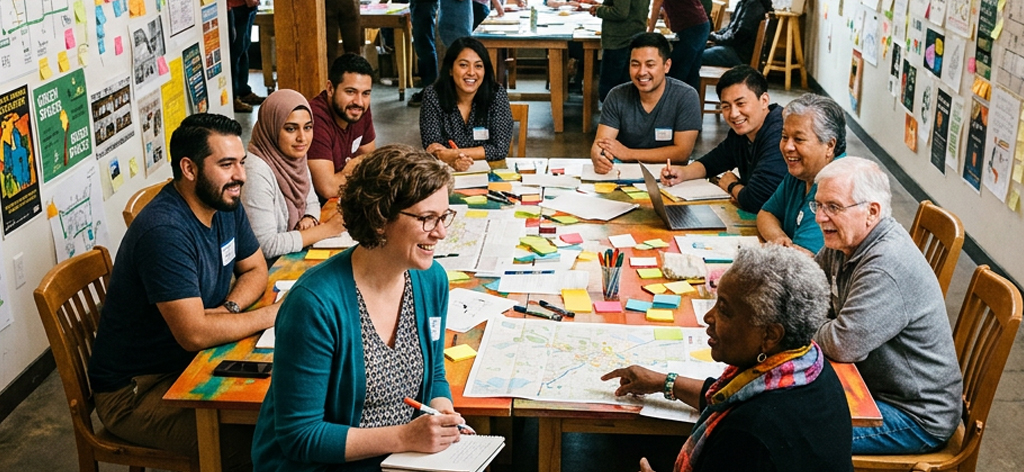
Design is about applying human-centered design principles, frameworks, and practices to improve products and services for people and markets, impacting better tomorrows. Designers use human-centered principles and methods to intentionally identify underlying values, behaviors, and actions that inform product and service infrastructures, thereby improving outcomes and agency. To achieve these goals, designers are active participants orchestrating desires, specifications, and outcomes – not neutral facilitators with clients and users.
The designer-as-orchestrator is a recent development. For many decades, designers focused on executing what clients told them to do through one-way instructions. After World War II and into the 1960’s, designers began to ask probing questions about the briefs clients generated by directly observing the current state, interviewing stakeholders, identifying root problems that may not have been immediately visible, and reframing briefs into more relevant and targeted interventions. This shift expanded designers’ agency and their depth of approaches. Designers also realized that users could play a direct role in exploring problems and opportunities through participatory design, creating, vetting, and implementing outcomes with users and other stakeholders.
The key tenets of human-centered design focus on the physical and emotional needs and desires of people, using empathetic approaches by:
- Identifying and solving the core issues behind an initial problem
- Understanding the larger social, political, economic, and ecological forces that influence or impact the problem
- Collaborating directly with people and stakeholder groups on the current state and options for future states
- Testing and refining thinking and prototypes, iteratively
- Taking a long-term systems view for resiliency
Participatory design (also called co-design and co-creation) involves designers collaborating directly with people, rather than designing for them with limited involvement. It is a way to have direct conversations, collectively socializing concepts, and securing alignment on change. It can also uncover historical cognitive, cultural, and behavioral habituations that can block options and hinder progress toward greater agency. Lastly, it can also highlight fears about possible implications of emerging changes, which may keep people in the imperfect status quo.
Participatory design is often interpreted by many as designers transferring their professional agency to users and placing them at the forefront. What is the balance between designer as instigator vs. collaborator? It is not a clear division but a combination of both to ensure that what is observed is mapped, all voices are heard, and that responsible/accountable or consulted/informed stakeholders contribute to options and then to a chosen solution, thereby ensuring greater acceptance.
People, users, and markets
Designers collaborate with people to effectively design for groups and markets. Any design response takes into account their goals and objectives within a given situation, as well as their underlying motivations and behaviors to achieve their job-to-be-done. In many ways, design is about supporting people’s agency by addressing gaps in their ability to exercise it effectively. Agency is defined by people’s ability to make decisions and take actions that enhance their sense of empowered control, humanity, and relationships in the environments where they interact and contribute at home, at work, and in social settings.
People live in an artificial world. In the Anthropocene, the human species has shaped everything we inherit and know. Humans are also social creatures who work in groups to accomplish goals. Everything, therefore, is socialized and is socially mediated. Participatory design is a way of directly working with people to socialize key concepts and the processes for changing the status quo. Even constraints, which can be viewed as limitations, are socially mediated and therefore can change.
People have often been called users. This term is a legacy of early computer engineers who reduced people to nodes that access a system as a functional relationship. People have also been called consumers, a term credited to Sidney A. Reeve in his 1921 book “Modern Economic Tendencies.” This term became associated with post-WWII-era efforts to link production to consumption through specific purchasing drivers and behaviors. Consumers are aggregated into markets and sub-markets to effectively market to them. People have also been called stakeholders, a term associated with R. Edward Freeman’s article “Strategic Management: A Stakeholder Approach,” which articulated interdependencies between an organization and groups as a system in which they have a stake in a desired outcome.
Organizations and companies that serve specific groups and markets often seek feedback or engage with markets to understand their preferences, tasks, and goals. People are only consulted and informed, and any information is used to shape or improve products/services so they are more relevant and used. However, it is not participatory design, in which people are part of the product/service development process and have a direct say in its creation.
Whether a person is called a person, a user, a consumer, or a stakeholder, these terms frame people as actors who operate in specific situations, with goals and objectives, to derive some benefit from their time and effort. Any product/service exists to deliver value to people and to address environmental, psychological, and physical factors that inform any design response.
This is where design and designers can connect organizational and market desire by bridging possibility to utility. This entails more than asking for a problem brief; it means understanding the substandard present and the desire to change it. Asking key questions as a starting point opens up areas to explore a problem space. Then, a designer orchestrates primary and secondary research and collaboration with stakeholders, diverging to challenge assumptions and gain collective insights that deepen understanding of the inner nature of something, with the goal of aligning people on important topics. Collective insights prompt people to re-examine their current understanding by creating powerful alternative views that usually challenge established thinking or call the status quo into question.
Most companies find participatory design too time-consuming and expensive to deploy at scale. Designers are reduced to finding information about specific people through secondary sources, with only light direct interaction. The collected information is then aggregated into personas that infer what people want in products and services. This is not participatory design because it is essentially extractive; people do not have a direct stake in the process.
Participatory design directly engages key stakeholders living within the current status quo to understand their lived realities (behavioral, resource, and process) and to bridge core issues with broader, unseen forces that may be the root cause of what is observed. Participants directly own the issues, define the specifications, and can even create some or all of the outcomes. Participatory design is often associated with mission-based initiatives that have a social dimension and focus on capability building.
Challenging the status quo – together
Organizations and companies operate within rapidly changing market landscapes shaped by fast-moving social forces, institutional and market processes, quickly evolving technological mixtures, and shifting market preferences. People either live in a world of choice, where relationships with organizations and companies can easily be broken, or they operate within specific contexts where their lived realities are under siege from historical gaps in purpose, substandard processes, and cognitive stressors that retard agency and outcomes.
Organizations/companies, and groups of people within them, are continually seeking ways to fix persistent problems. The number of choices in any specific market segment or industry allows people to select among several seemingly equivalent alternatives. Companies and organizations seek a competitive advantage and/or want to increase the level of engagement of particular groups to derive specific economic or productivity benefits. By understanding at a deeper level, beyond the surface transaction, values, beliefs, behaviors, and actions can be incorporated to create more relevant experiences and outcomes.
Improvement and change go hand in hand. The goal is to change the status quo, or the current state of things. They are the invisible operating instructions that unquestionably order our world as a habituated intuitive construct. Societal values, rules, behaviors, and actions drive repeatable patterns and shape predictable expectations and outcomes. People and markets absorb the status quo and operate on autopilot, accepting it as the normal mode of reality. Many chafe at the status quo and may consider making small or larger changes to reduce stress, feel more engaged, and achieve specific benefits.
Having people involved using participatory design frameworks and methods is also about exercising potential power. What is power? There are two key meanings. First, power is about maximizing human potential and capabilities. Participatory design provides space for people to reimagine themselves in specific situations without the constraints of the status quo. Second, related to the first, it is about people power, or the collective effort to address systemic social, political, and economic controls that may keep a specific group in a substandard situation. Usually, the status quo views any proposed increase in human potential and capability as a loss of power over people who may attain greater agency. So it is less about change and more about a change in power dynamics.
This issue of power can affect an organization’s/company’s desire for change, which may be blocked by inertia, a lack of focus or alignment, or a lack of the skills and capabilities to make meaningful progress. The only way to change the status quo is to question the existing order of things and propose new value. Possibility is about questioning the status quo using creativity and imagination. Constraint is about recognizing the status quo by integrating aspects into new futures through ingenuity. Yet change can be disruptive, and people and markets don’t want its negative consequences. In most cases, people and markets try workarounds as ad hoc responses, with little desired effect.
People want change, but also become concerned about the extent of relearning or behavioral change required to achieve a desired benefit. There are also power dynamics within a group of people, all of whom are concerned about changes in status and power, the unknown, and the level of unwanted risk when considering any change. If the unknowns or risks are deemed too great, then people will stay with the status quo, where the devil you know is better than the devil that you don’t. Lastly, people may not have the capacity to activate and manifest the desired change that designers can provide.
A prime example of this from an earlier period is the work of Raymond Loewy, the expatriate American industrial designer who appeared on the cover of Time Magazine in 1949 for innovative work in product design, advertising & marketing. In his successful career of innovation, he reflected on how he persuaded companies to accept his design recommendations, which, in many cases, were way ahead of current market acceptance. He created a structured approach to do product development called “most advanced, yet acceptable” (MAYA), which recognized that companies and markets would only change so much over specific timeframes and that design had to change the status quo just enough to advance engagement for competitive advantage. If a design solution is too advanced or unfamiliar to markets, they will reject it and opt for something more familiar. The goal of MAYA was to thread the needle between the status quo and a future with just enough change and value to prompt desired market responses. Popularized in 1954 by Brooks Stevens, planned obsolescence involved creating product roadmaps and iterative releases, with a product gaining a broader range of features once earlier features were accepted. The automotive industry is a good example of this in practice.
Participatory design benefits from a designer’s unique ability to engage with people, ask key questions, and use structured exploration to focus limited resources on understanding the current state is an important skill that can overcome persistent inertia.
Designing with people and designing for people
What is the purpose of participatory design, and what level of influence do people have in co-creating desired outcomes? It is to empower traditionally disenfranchised groups to re-engage by providing a safe space to have a voice and directly drive change by developing the purpose, benefits, specifications, and resources needed to achieve the desired end state.
Design, in its broadest sense for all humans, starts with intention, then develops a plan to achieve an intended outcome through objectives and tactics. Designers are educated and trained to balance open collaboration with focused outcomes that many stakeholders may never have considered or conceptualized. This is both a challenge and an opportunity for designers to create more relevant outcomes that matter. Ezio Manzini, the Italian design theorist was a proponent of social innovation, delineated distinctions between design for people, design with people, and design by people. Designing for is assuming what people want or need, designing with is engaging with people who live the problem as co-creators, and design by are where people have the capability to design outcomes on their own
As this article has outlined, when designing with people, humans are complicated as collaborators because they do not make objectively rational decisions but instead satisfice their way toward progress. Entrenched thinking, values, and habituated behaviors can block meaningful progress because, in many cases, people hold themselves back. Designers, therefore, have to balance designing with people’s sum total of lived experience and collective shared interests, while recognizing the limits of participatory design through stakeholder engagement.
Designing with people using human-centered design means giving stakeholders an opportunity to be heard and to recognize their value, contributing to an understanding of the spectrum of mental models and the emerging alignment of shared interests, which can inform a reframed problem statement.
Designing for people using human-centered design means an expedited way to understand human emotional and logical needs and wants in an understandable order, and to design options that account for habituation and resistance to change, and that incentivize new behaviors to achieve desired benefits.
Gaining a deeper understanding by observing, interviewing, and collaborating with people can provide key information on beliefs, behaviors, and actions, as well as on unseen social, economic, political, and technological forces that impact them. Having the same people consider possible future changes and experiences to correct the problem for greater benefit also has direct benefits, because it provides buy-in for any response.
In social design, people are the designers, implementers, and recipients of any change, with designers assisting them. This can be very appropriate as a form of capability and community building for greater agency. In most cases, direct people involvement has a smaller footprint and does not directly shape or implement the changes, as these are done by organizations/businesses that provide the products/services they use. In this case, the designer is facilitating and orchestrating primary and secondary information flows guided by human-centered design principles and practices.
Ashish Bansal, who was Vice President of Corporate Marketing at Samsung for many years building design research capabilities reflected on designers orchestrating the goals of organizations and users by stating “This orchestration is not a surrender of agency but an expansion of it, where the designer uses their expertise to provide a safe space for stakeholders to have a voice while maintaining the responsibility to steer the project toward viable outcomes.”
Designing with and for people means designers integrate the design of the general with the design of the specific, in a value chain across the double diamond. If designers are the facilitators and orchestrators of change and improvement, then they have to design with people and then design for the very same people. Once participants identify possible options, a designer can take into account habituations and resistance to change, and incentivize new behaviors to achieve desired benefits.
After 60 years of participatory design, direct collaboration with people is now mainstream. Organizations and companies now see the value of their inclusion in product/service creation and improvements. In some cases, it is still focused on designing for with light involvement from people, and in other cases, it is designing with for total immersion and capability building of people and communities. Both seek to secure direct information, feedback, and co-creation. It is not a perfect integration, but it is a recognition that incorporating people by design into the active exploration and creation of better futures yields more sustainable outcomes than reducing people to abstract personas and designing for abstract assumptions. The tension between designing “with” and “for” works together to create by integrating direct participation and designers’ expertise for better outcomes through greater agency for people and groups.


